Article
Preparing the article…
If a translation is needed, this may take a few seconds.
If a translation is needed, this may take a few seconds.
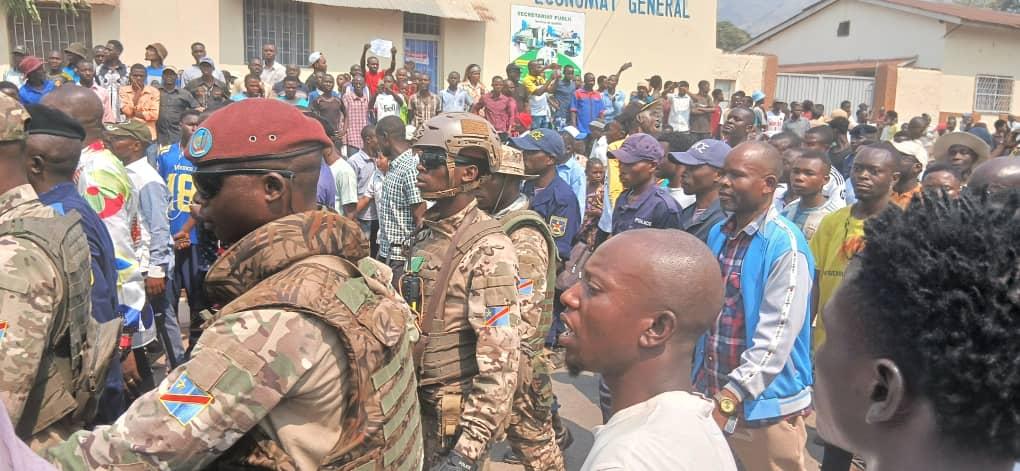
The Armed Forces of the Democratic Republic of the Congo (FARDC) announced they have achieved significant military advances in South-South Kivu, marking a new stage in operations launched against armed groups active in this part of the province.

The Armed Forces of the Democratic Republic of the Congo (FARDC) announced they have achieved significant military advances in South-South Kivu, marking a new stage in operations launched against armed groups active in this part of the province. Several strategic positions, until now occupied by AFC/M23 fighters, are now under the control of regular forces.
According to Lieutenant Mbuyi Kalonji Reagan, spokesperson for Sukola 2 operations, the engaged units conducted coordinated offensives in several sensitive zones. These actions enabled the recapture of Katogota, Kaziba center, Point Zéro, as well as other surrounding localities where rebels had established fallback bases or pressure points against civilian populations.
The recently recaptured positions constitute, according to the FARDC, major routes allowing the securing of transit zones essential for residents and for the army's logistical operations. The recapture of Katogota and Kaziba, in particular, is presented as an important tactical advantage, these localities being often considered as mandatory passages between several South Kivu territories.
The spokesperson emphasizes that the objective of these offensives is not only to neutralize rebel positions but also to reduce their capacity to influence surrounding villages, where insecurity has disrupted economic activities and caused population displacements in recent months.
The FARDC claims to have inflicted heavy human losses on AFC/M23 fighters during these operations. They also indicate they have seized several weapons, ammunition as well as improvised explosive devices (IEDs) which, according to them, were used to hinder the access of regular forces and sow fear among local communities.
Although the army does not specify the exact toll, it assures that these operations aim to sustainably diminish the offensive capabilities of the rebel group, often accused by authorities of conducting targeted attacks against military positions and acts of intimidation against civilians.
The FARDC recall that these operations are part of a broader plan to stabilize South-South Kivu. Sweeping, control and consolidation operations are still ongoing in several mountainous or difficult-to-access zones, where pockets of resistance are reportedly still active.
The army stresses that the restoration of state authority remains one of the central objectives of this deployment. This involves not only the continuation of military operations but also the gradual deployment of essential public services, the reopening of certain road axes and the reactivation of local administrative structures in secured zones.
Military authorities urge local populations to remain vigilant and collaborate with security forces. They insist on the need to provide reliable information enabling the identification of suspicious movements, to prevent rebel infiltration and to protect recently secured areas.
Our editors' picks of what matters. Monday to Friday.
By subscribing, you accept our privacy policy.