Article
Preparing the article…
If a translation is needed, this may take a few seconds.
If a translation is needed, this may take a few seconds.
Makhtar Diop has just been appointed chief executive of the International Finance Corporation, the World Bank's branch responsible for the private sector. Until now, he held the position of World Bank vice president for infrastructure. His tall, slender frame has been walking the corridors of the World Bank for twenty…
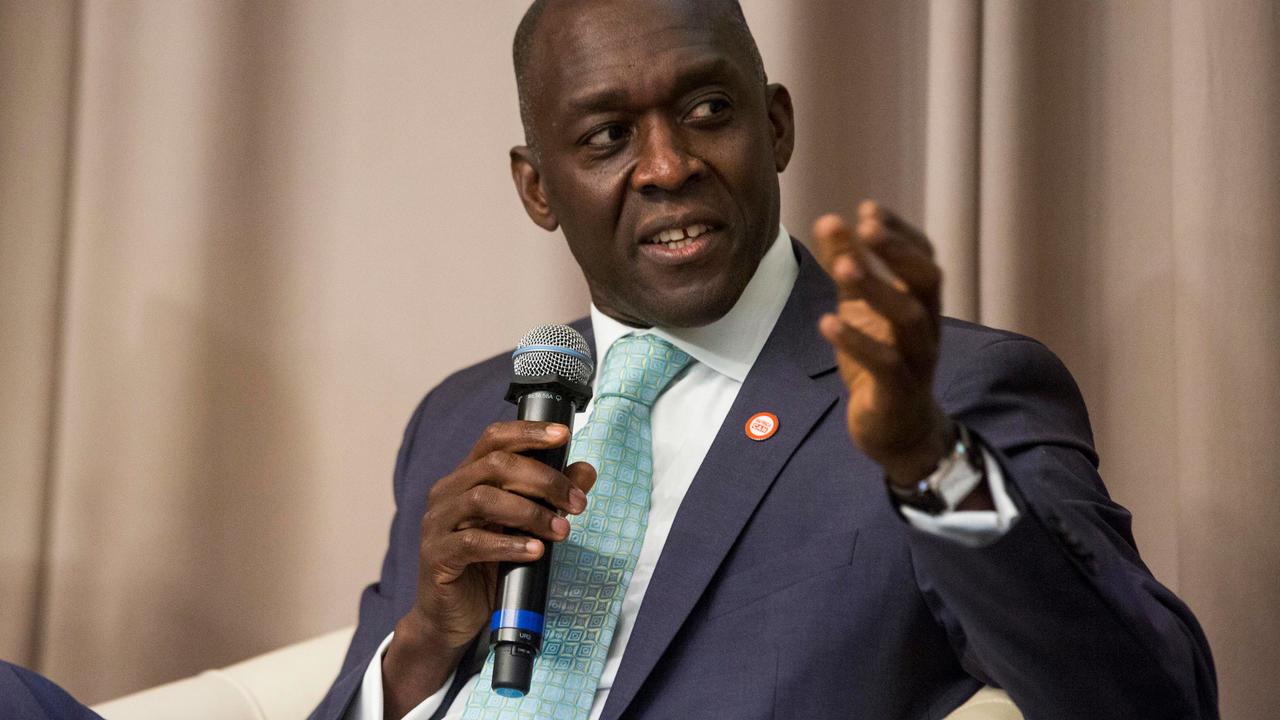
His tall, slender frame has been walking the corridors of the World Bank for twenty years. Within the institution, Makhtar Diop has held practically every position. Country director, regional director, vice president in charge of Africa, then in charge of infrastructure.
This karate enthusiast, a sport he practiced at university level, is thus also a champion in the art of climbing the ranks.
Although he has become one of the planet's leading financiers, Makhtar Diop experienced a student youth rather marked by left-wing, even far-left views, much like the era itself, which was a legacy of May 1968. Senegalese journalist Demba N'Diaye knew Makhtar Diop in Normandy in the late 1970s. They were active together within the association of Senegalese students in France:
"In general assemblies, he was very active. He was a big voice who always had something to say. Even if you weren't on the same side, you couldn't fail to recognize his great capacity for analysis and his ability to defend his points of view. There was relevance in his ideas. And he defended them tooth and nail. Besides, to stop him and get him to shut up was complicated!"
This son of a lawyer chose to study economics and continued his studies in England. Upon his return to Senegal, he became a financial analyst, then joined the IMF, before subsequently taking the position of minister of economy and finance of Senegal in April 2000. A fairly classical career path in the end. But what is less so are Makhtar Diop's economic conceptions. As he explained in 2015 on the microphone of Jean-Pierre Boris:
"You cannot be simply a technocrat; you are obliged to understand the political economy of a country, you are obliged to understand the culture, the conditions and the determinants of what makes a society move, in order to try to change it. The economy is an essential dimension of the development of a nation and a society, but it is not everything."
"He was forged in this state voluntarism which assumes that not only the state leads reforms, but also ensures that investments are implemented."
Moubarack Lô is currently the chief executive of Senegal's economic foresight bureau. In the 1990s, he worked with Makhtar Diop at the ministry of economy and finance.
"English labour or theorists of endogenous growth. I would classify him rather in that school which promotes development through infrastructure, human capital, technological development and innovation. I think all this somewhat illustrates Makhtar Diop's thinking. And that is what drives his daily action today at the World Bank."
At sixty years old, he who regularly figures in the rankings of Africa's most influential people on the planet has become one of the great architects of public development policies. At the head of the International Finance Corporation, he will be responsible for supporting the private sector. But for him, the objective remains the same: the development of emerging economies.
Our editors' picks of what matters. Monday to Friday.
By subscribing, you accept our privacy policy.