Article
Preparing the article…
If a translation is needed, this may take a few seconds.
If a translation is needed, this may take a few seconds.
Félix Tshisekedi and Yoweri Museveni met in Kampala to discuss crucial issues, including security and trade exchanges.
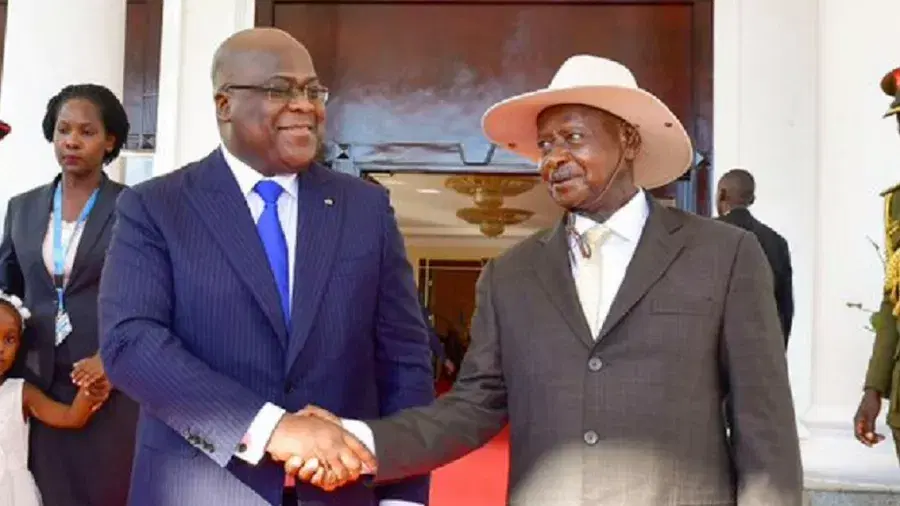
During a meeting held on Monday at the State House in Kampala, Congolese President Félix-Antoine Tshisekedi and his Ugandan counterpart Yoweri Museveni addressed various topics, including security at their common borders, oil-related issues, and the development of bilateral trade.
At the end of this meeting, six memorandums of understanding were signed, resulting from discussions held during the ninth session of the joint permanent commission between the two countries. These agreements aim to strengthen cooperation in key areas such as security, trade, and energy.
On the security front, Museveni emphasized the importance of stabilizing the regions of North Kivu and Ituri in the Democratic Republic of Congo (DR Congo). He stated: “We need a mixed Congolese-Ugandan command to eradicate what remains of the ADF,” an armed group active in this region. This initiative aims to jointly address the security challenges affecting both nations.
Regarding trade exchanges, Tshisekedi expressed his desire to achieve a bilateral trade volume of 1 billion US dollars. To this end, a roadmap will be developed within a month to facilitate Uganda's opening of a credit line with the Congolese government. This approach is seen as an important lever to boost trade between the two countries.
The meeting takes place in a context where the DR Congo and Uganda are seeking to strengthen their economic partnership while managing growing security concerns. Previous discussions between the two heads of state had already highlighted these issues, such as in March 2019 when Tshisekedi and Museveni exchanged views on the need to improve security at their borders.
The progress made during this recent meeting could have positive repercussions on regional stability, as both countries commit to collaborate more closely to address common threats. Observers are keenly awaiting the implementation of the signed agreements and their impact on the economic and security climate in the region.
Our editors' picks of what matters. Monday to Friday.
By subscribing, you accept our privacy policy.